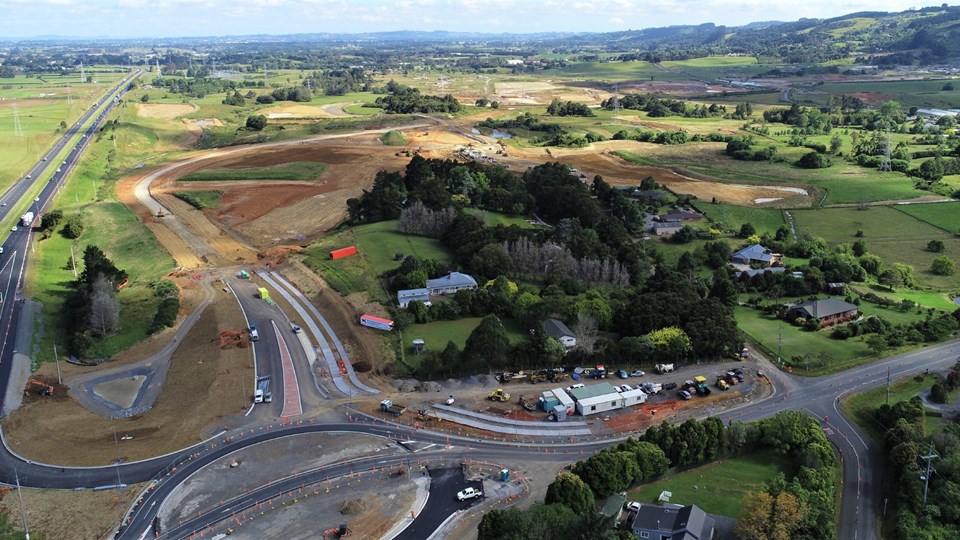
New Roading Network Set to Provide Safer Alternative to SH1 in South Auckland

newramaramainterchange.png

A new South Auckland roading project is set to reduce the number of heavy vehicles passing by a local school, create kilometres of public walking and cycling pathways and provide vehicles with an alternative to State Highway One.

The privately funded roading network at Drury South Crossing, the country’s largest industrial and residential development, will see the creation of a new 6km urbanised roading network and a reduction in the number of heavy vehicles passing Ramarama School and residents on Ramarama Road.

Drury is one of the country’s fastest-growing areas with a population expected to soar by over 60,000 in the next 30 years. 

The project will also include the construction of 5km of walking and cycling paths, as well as a 4km shared path from Drury village to Drury South Crossing.  

The Council proposed Mill Road project will provide an alternative to State Highway One and provide a new North-South connection from Manukau to Pukekohe via Drury South Crossing.

Stephen Hughes, CEO of Drury South Crossing, says to facilitate the Drury South Crossing development a number of existing roads need to be closed and new roads created. 

He says from late September 2020 the Southern section of Ramarama Road will be permanently closed while the northern section of the road will remain open. 

Traffic will use the newly constructed Maketu Road instead of Raramarama Road with the connection to Fitzgerald Road retained.

“The new roading layout with the development area has been the subject of comprehensive technical assessments through various Council planning processes.

“An improved transport environment is being created with lower speed zones on new urbanised roads replacing the higher speed limits on rural roads.

“One of the key outcomes of this development will be an upgraded road network which reduces the heavy traffic at Ramarama School - an education facility whose rolls are expected to surge as the local population increases in the coming years,” he says.

The 360-hectare, mixed-use Drury South Crossing development is expected to contribute $2.3bn to the economy and employ 6,000 Kiwis when completed in 2027.

For media information, interviews or images, please contact Impact PR

Screen Shot 2020-09-28 at 3.29.30 PM.png

COVID-19: Planning for Major New Projects at NZ’s Largest Industrial and Residential Development Underway

Screen Shot 2020-09-28 at 3.29.43 PM.png

More than a fifth of the 170 hectares of commercial land available at the country’s largest industrial and residential development have now been sold as businesses look to establish large scale local operations in a post-COVID environment. 

The development is expected to contribute $2.3bn to the economy, employ 6,000 in the distribution, food processing, tech, manufacturing and logistics sectors and provide affordable housing for 2,000 Kiwis when it is completed in 2027. 

Construction on the first of these new warehouses and commercial facilities will begin in late  2021 - with this phase also expected to provide an employment hub for the region.

Stephen Hughes, CEO of Drury South Crossing, a 361-hectare mixed-use development in South Auckland, says already several food suppliers are looking to establish high volume capability locally and there is also interest from a diverse range of other industries including logistics providers and a 10,000 sqm data centre. 

Hughes says he’s also had enquiries from US film studios looking to develop some of the land into sound stages and production facilities.  

“The agricultural sector is seeing strong growth potential for New Zealand branded products as the pandemic stretches supplies around the world and consumers focus their attention on where their food is sourced from,” he says.  

He says increasingly businesses operating at that level need a sizable footage in order to accommodate higher levels of automation. 

“What we are seeing is a need from local food producers to store large volumes of export ready product where it can be accessed using automated storage retrieval systems (ASRS), and robotic technology to access products from warehouses that are of a scale we have not generally seen in New Zealand.

“There are relatively few sites left in the Auckland region which can accommodate this scale of operation and it has been encouraging to see that local and international businesses are looking to invest at this level - which will be an essential part of the region’s economic recovery,” he says.

Along with the growth in local business development, Hughes says a clear reentry pathway into the country is needed for multinational organisations wanting to partner with us.

“This is one of the few times in our modern history where our geographic isolation is a clear competitive advantage and we are going to need more than international students and tourists to restart the economy.

“As a nation we need to create new infrastructure and manufacturing opportunities to provide New Zealanders with some control and certainty over their future. 

“We have multinational executives queuing at the country’s door to develop new operations and jobs here. Unfortunately, there is only so much we can do over email and Zoom calls before they need to physically visit the site of their future investment,” he says.

Hughes says consideration is going to be needed as to how these visitors are treated as they come through our quarantine process.  Whilst this process is critical to protect Kiwis, a one size fits all approach is not necessarily conducive to securing investments and jobs at the level the country needs.

For media information, interviews or images, please contact Impact PR

Massive Drury South Crossing business park

6:26 PM Wednesday January 23, 2019
Paul Charman

true-commercial-drury-south-crossing-industrial-park-development-site-aerial.jpg

An aerial view of the Drury South Crossing development site. Photo / Supplied

With Auckland in dire need of industrial land, civil works are well advanced for Stevenson Group’s $800 million, 361ha Drury South Crossing business park development.

Businesses are checking out the sites on which some building could begin in about 12 months.

Drury South Crossing CEO Stephen Hughes says 200 people attended an on-site community open day late last year.

“We have been a little surprised with the strength of inquiry for sites and are certainly further ahead with sales than we expected to be at this stage,” he says.

Hughes says Drury South Crossing has blocks of up to 20ha for buildings, warehouse and factories; is close to main routes north-and-south; and has solid relationships with regulators, iwi and the public.

The Stevenson Group has worked co-operatively with Auckland Council — particularly Watercare Services and Auckland Transport — to develop the land between its Drury quarry and the Southern Motorway.

This required extensive local consultation and agreement with council on a timetable and funding plan to create a new roading network, linkages with existing roads, water, stormwater and sewerage services.

“All the necessary environmental consents have been obtained and we’ve also worked alongside local iwi and particularly Ngati Tamaoho, to ensure future of the neglected Hingaia and Maketu Streams, which flow through the overall site.

“These waterways are being remediated, and there will be extensive native planting undertaken,” says Hughes.

“This will become a feature of the overall development, and a new wetland area will treat and improve water quality entering the Hingaia stream.

“About 90ha of the original Stevenson site will be used for these modifications, plus new community facilities, including recreation areas, parks, walking and cycling tracks.”

Auckland Council too has helped to co-ordinate the major public works associated with project, which carries lofty expectations over the next few years.

It is intended all this will deliver thousands of jobs and houses; a new roading pattern for the area; enhanced local amenities and the restoration of significant streams and wetlands.

Hughes explains that Stevenson rationalised its formidable land holdings in the area in order to focus on the 361ha business park.

The company recently sold its 45ha Special Housing Area (one of three in the immediate area) to Classic Developments, part of the Classic Group of companies that also includes national group home builder Classic Builders.

Up to 800 homes will be built, starting this year, with a focus on affordability.

Stevenson also recently sold its quarry and construction materials business to roading contractor Fulton Hogan. Hughes knows his customers are responding to a general shortage of industrial land in Auckland and connectivity in city’s fast-growing south.

“Buyers will have direct access to-and-from metropolitan Auckland and its port to the north, plus to the Port of Tauranga and the various inland ports and distribution centres in South Auckland and Hamilton,” he says.

“We are in negotiations on several large blocks of up to 20ha — the development could be more-than-half sold by late 2019.

“Potential investors see the opportunity to purchase sites outright, rather than lease them; and acquire large blocks in line with business strategies.”

Stevenson says buyers have been chasing sites from half-a-hectare, right up to 30 hectares.

“And, while one of the first purchasers is a Hamilton company wanting to shift north, most inquiry has come from Auckland businesses. Sites are being made available progressively as complementary public works are completed,” he adds.

Construction of the first commercial buildings, warehouses and factories is expected to commence in a little over a year.

Hughes says the location is surrounded by supporting infrastructure. It is immediately to the east of the State Highway 1 Southern Motorway and Great South Rd - between the Drury and Ramarama turnoffs - with services close by.

An added attraction for site purchasers is three new housing estates adjoining the business park; with planning at various stages for town centres; retail and community facilities; a school; a railway station and a hotel.

“A large proportion of staff employed in the new businesses is expected to live locally, leading to short commutes. Site works to enable housing development is underway.

The massive business park project is expected to create over 5000 new jobs directly and a further 10,000 indirectly in the Auckland region. It is expected to contribute almost $800 million-a-year to GDP locally, plus a further $2.3 billion annually to regional GDP.

Hughes expects that over the construction phase there will be an additional, one-off contribution to GDP of about $700m.

Though a relative newcomer as a major developer, Stevenson Group has been active for more than a century in mining and quarrying — plus industries including agriculture — throughout New Zealand.

Hughes says a strategy of providing a ‘win-win’ for all parties surrounding its South Auckland quarry asset seems to have paid off. “Our aim has been to meet the needs of businesses and home owners, while improving the natural environment,” says Hughes.

“All this, while ensuring continuity of the supply of aggregates which are so vital for the future development of both city and region

STRONG DEMAND FOR INDUSTRIAL LAND DRIVING WORKS PROGRAMME AT DRURY SOUTH CROSSING

Logo Background.jpg

Stevenson Group is experiencing surging demand for building sites at its $800 million “Drury South Crossing”, the  largest such business park  development in Auckland.

Drury South Crossing is the largest land holder in the area, and announcement of the project was a catalyst for major growth plans in the wider Drury region. The development will  deliver thousands of new jobs and houses, a new roading pattern for the area, greatly enhanced local amenities and the restoration of  significant streams and wetlands.

Civil works are well advanced and building construction will begin next year. More than 200 people attended an on site open day for the community last month.

The company has worked closely with Auckland Council, including Auckland Transport and Watercare Services, to ensure completion of major public works is closely coordinated with various projects being undertaken by private enterprise.

“This approach has worked well for all parties”, says Stevenson Drury South Crossing CEO Stephen Hughes. “The various private developers are also taking a cooperative approach to ensure a cohesive final outcome.

“We have been a little surprised with the strength of sales enquiry for the Drury South Crossing sites, and are further ahead with sales than we expected to be at this stage of the development. This is a reflection of business confidence in Auckland, as well as on the shortage of developed commercial and industrial land, especially the larger sites which involve a significant contribution by the purchaser.”

Stevenson is rationalising its other land holdings in the area to focus on the massive 361 hectare Drury South Crossing business park and  recently sold its 45 hectare Special Housing Area (one of three in the immediate area) to Classic Developments, part of the Classic Group of companies that also includes national group home builder Classic Builders. Up to 800 homes will be built, starting in 2019 with a focus on affordability.

Stevenson also recently  sold its quarry and construction materials business to roading contractor Fulton Hogan.


LOCATION AND ACCESS

Stephen Hughes says buyers of sites in Drury South Crossing  are responding to a general shortage of industrial land in Auckland and value the unique location and connectivity in Auckland’s fast growing south. Buyers will have direct access to and from metropolitan Auckland market and its port to the north, but also to the Port  of Tauranga and the various  inland ports and distribution centres in South Auckland and Hamilton.

“That’s how Drury South Crossing got its name – the massive growth plans for the region are well known and the connectivity from Drury South to various key destinations is summarised in the word “crossing”.

“Demand for sites is strong, we are currently in negotiation on several large blocks of up to 20 hectares, and the development could be more than half sold by late 2019. Potential investors see the opportunity to purchase sites outright, rather than lease them, and the availability of large blocks of land, as reinforcing their chosen business strategy.”

He says buyer enquiry has been for sites as small as half a hectare up to 30 hectares, and while one of the first purchasers is a Hamilton company wanting to shift north, most enquiry has come from Auckland businesses. Sites are being made available progressively as complementary public works are completed.

Construction of the first commercial buildings, warehouses and factories is expected to commence in a little over a year.

Drury South Crossing is surrounded by supporting infrastructure. It is immediately to the east of the Southern Motorway and Great South Road, between the Drury and Ramarama turnoffs, with services close by.

An added attraction for purchasers at Drury South Crossing is the three new housing estates adjoining the business park, with planning at various stages for town centres, retail and community facilities, a school, a railway station and a hotel. A large proportion of staff employed in the new businesses is expected to live locally, leading to short commutes. Site works to enable housing development is underway.

Drury South Crossing is expected to create over 5,000 new jobs directly and a further 10,000 indirectly in the Auckland region, as well as directly contributing nearly $800 million a year to gdp locally and a further $2.3 billion annually to regional gdp. Over the construction phase there will be an additional, one-off contribution to gdp of about $700 million.


CLOSE COOPERATION WITH COUNCIL

Stevenson Group is  a significant private company which has been  active for more than a century in mining, quarrying, and other industries, including agriculture, throughout New Zealand.

The company has   worked with Auckland Council, particularly Watercare Services and  Auckland Transport, utilising the 361 hectares of land between its Drury quarry and the Southern Motorway to the west to protect the quarry’s operational capabilities in the future.

This has involved extensive local consultation and agreeing with Council on a timetable and funding plan to create a new roading network, linkages with existing roads, water, stormwater and sewerage services. All necessary environmental consents have also been obtained.

Drury South Crossing have worked with local iwi and particularly Ngati Tamaoho to ensure that the neglected Hingaia and Maketu streams, which flow through the overall site, are being remediated, and extensive native planting undertaken. This will become a feature of the overall development and a new wetland area will treat and improve water quality entering the Hingaia stream.

Some 90 hectares of the original Stevenson site will be used for these modifications and for new community facilities including recreation areas, parks, walking and cycling tracks.  

Drury South Crossing is a project on which Stevenson Group has been working very closely with Auckland Council because of its sheer size, its pivotal role as a catalyst in the overall development of the area and the need for major supporting infrastructure to be funded and created on an agreed timetable.

John Dunshea, General Manager of Council’s Development Programme Office, says the collaborative approach has enabled private investment funds to create new business, employment and residential opportunities in  a market-attractive area.

“Our main focus is to get the planning and infrastructure ‘right-sized’ for growth.

Auckland Council is currently preparing structure plans for Drury, Pukekohe and Paerata.

“Their combined future yield could see more than 23,000 new houses built and further significant growth based around rail providing a more resilient transport network,” said Mr Dunshea.

SiteplanforHeraldPublication.jpg